 15 Oct
In the expansive domain of cryptocurrency consensus mechanisms, Proof-of-Work (PoW) remains the bedrock of uncompromised network security. Yet, not all PoW algorithms are engineered alike. While Bitcoin's SHA-256 algorithm relies heavily on pure mathematical computing power\u2014making it predominantly processor- and clock-speed-bound\u2014the Scrypt algorithm was deliberately engineered with an entirely different cryptographic philosophy: memory hardness. Designed specifically to resist custom hardware monopolization and level the computational playing field, Scrypt has evolved over the past decade into the operational foundation of two of the world's most resilient decentralized payment networks: Litecoin (LTC) and Dogecoin (DOGE).
For modern cloud mining participants, understanding how the Scrypt algorithm functions at a hardware and mathematical level is not merely an academic exercise. Through the revolutionary mechanism of Merged Mining (Auxiliary Proof-of-Work / AuxPoW), Scrypt enables a single stream of computational hashpower to secure both the Litecoin and Dogecoin networks simultaneously without sacrificing performance. This dual-yield capability dramatically alters the economics of cloud hashrate contracts, unlocking compound profitability and reduced volatility for smart investors.
Deploy dedicated Scrypt hashrate today to mine both Litecoin and Dogecoin simultaneously with zero hardware maintenance.
Explore Scrypt Mining Plans »Developed in 2009 by Colin Percival originally for online backup encryption (Tarsnap), the Scrypt algorithm was introduced to the blockchain ecosystem by early cypherpunks seeking an alternative to Bitcoin's SHA-256. By 2011, Bitcoin mining had rapidly transitioned from home CPUs to high-performance graphic cards (GPUs) and early Field Programmable Gate Arrays (FPGAs), raising legitimate concerns regarding hashrate centralization in the hands of specialized hardware cartels.
Percival's breakthrough with Scrypt was the intentional requirement of significant amounts of pseudorandom physical memory (RAM) during hash computation. Unlike SHA-256, which evaluates mathematical rounds in microsecond loops that require virtually zero cache storage, Scrypt forces the computing chip to write and access large blocks of cryptographic noise within memory tables. This memory-intensive architecture made the manufacturing of Application-Specific Integrated Circuits (ASICs) drastically more expensive and architecturally complex during the early years of altcoin development.
At a granular computational level, Scrypt achieves memory hardness by combining a standard hashing function (typically PBKDF2 with HMAC-SHA256) with a memory-consumption function known as SMix. The algorithm proceeds through three distinct phases:
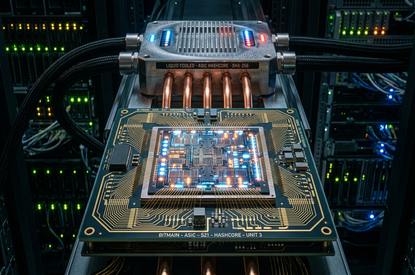
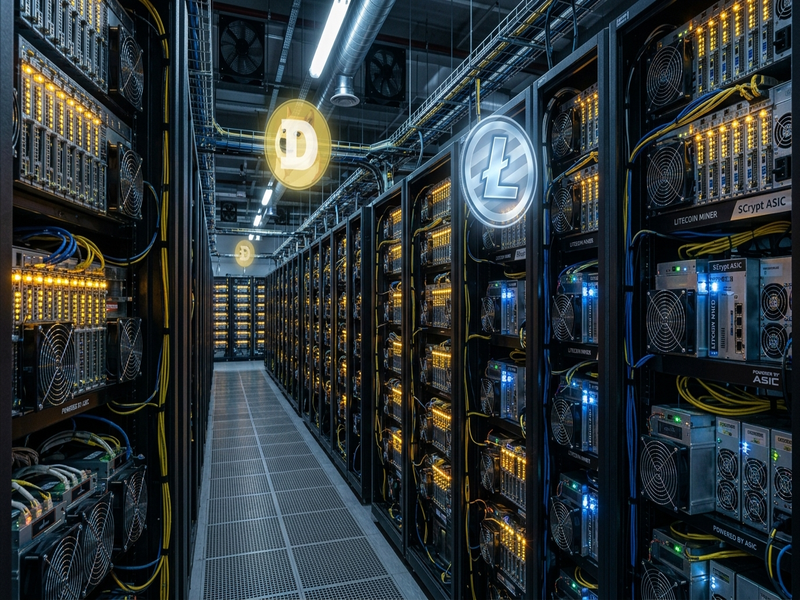
Because accessing high-speed on-chip RAM consumes both physical silicon area and continuous electrical wattage, designing modern Scrypt ASICs (such as the Antminer L7 or ElphaPex DG1) requires substantially larger die sizes and advanced thermal cooling dissipation compared to SHA-256 chips of equivalent manufacturing nodes.
In 2014, Dogecoin faced a critical existential threat. As a fast-growing meme cryptocurrency with a 1-minute block time and a declining reward subsidy, its total network hashrate dropped precipitously, leaving it highly vulnerable to potential 51% double-spend attacks. Recognizing the danger, Litecoin founder Charlie Lee proposed a transformative technological alliance: Merged Mining through Auxiliary Proof-of-Work (AuxPoW).
AuxPoW allows a miner to use the cryptographic work performed on a "Parent" blockchain (Litecoin) to simultaneously satisfy the difficulty requirements of an "Auxiliary" blockchain (Dogecoin). The magic of this protocol is mathematical: because both chains utilize the identical Scrypt hashing algorithm, a candidate hash calculated for a Litecoin block can also be checked against Dogecoin's target difficulty.
While early cryptocurrency hobbyists mined Scrypt tokens using custom desktop computer rigs, the evolution of the algorithm has transformed the operational economics completely. Today, running physical Scrypt hardware at home presents severe practical obstacles:
Cloud mining platforms like MineX Farm eliminate these friction points entirely. By aggregating thousands of high-density Scrypt units in dedicated, hydro-cooled data centers powered by sub-$0.03 renewable energy, users access institutional economies of scale with zero physical management, zero noise, and automated daily payouts sent directly to non-custodial wallets.
From an asset allocation perspective, mining Scrypt coins offers a powerful hedge against pure Bitcoin concentration. While Bitcoin functions primarily as digital store-of-value and institutional collateral ("digital gold"), Litecoin functions as a veteran, high-liquidity transactional settlement layer ("digital silver"), and Dogecoin has cemented its position as the premier viral peer-to-peer micro-tipping currency of the internet.
By capturing daily yields across both LTC and DOGE through a single, diversified Scrypt cloud mining contract, investors harvest dual revenue streams that can be automatically reinvested into expanding virtual rack hashrate or compounded through systematic dollar-cost averaging into long-term cold storage holdings.
Every new account on MineX Farm receives a complimentary $10 welcome miner to experience instant cloud hashing firsthand.
Claim Your $10 Starter Miner »Register your free account on MineX Farm today and instantly activate your complimentary $10 Starter Miner (50 MH/s). Real-time balance accumulation, zero hardware maintenance, and daily withdrawals.