How ASIC Mining Chips Actually Work: The Science Behind Proof-of-Work
In the early days of cryptocurrency, anyone with a standard laptop could fire up a CPU, run a few lines of code, and successfully mine dozens of Bitcoins from their bedroom. Today, the global hashrate exceeds hundreds of exahashes per second, secured by colossal data centers housing millions of specialized microchips. At the beating heart of this multi-billion dollar computational fortress lies a single technological marvel: the Application-Specific Integrated Circuit (ASIC). But what actually happens inside an ASIC die at the microscopic level? How does pure silicon convert electricity into immutable cryptographic consensus?
The Evolution of Hash Computation: Why CPUs and GPUs Fell Behind
To grasp why ASICs dominate modern Proof-of-Work networks, we must examine the fundamental design differences between computing architectures:
- Central Processing Units (CPUs): General-purpose processors designed to execute diverse tasksfrom rendering spreadsheets to running web browsers. They feature large cache memories and complex branch predictors, making them extremely versatile but wildly inefficient for repetitive mathematical loops.
- Graphics Processing Units (GPUs): Massively parallel processors built with thousands of smaller cores to calculate matrix math for 3D graphics and AI neural nets. While far superior to CPUs for hashing, GPUs still expend enormous electrical energy maintaining flexible programmable instruction sets.
- ASICs: Silicon microchips engineered from the ground up to execute only one single mathematical algorithm and nothing else. An ASIC designed for SHA-256 cannot render a 3D polygon, browse the internet, or calculate an audio file; it exists solely to compute cryptographic double-hashes at blistering speeds with minimal wasted power.
Silicon Architecture Demystified: The Anatomy of an ASIC Chip
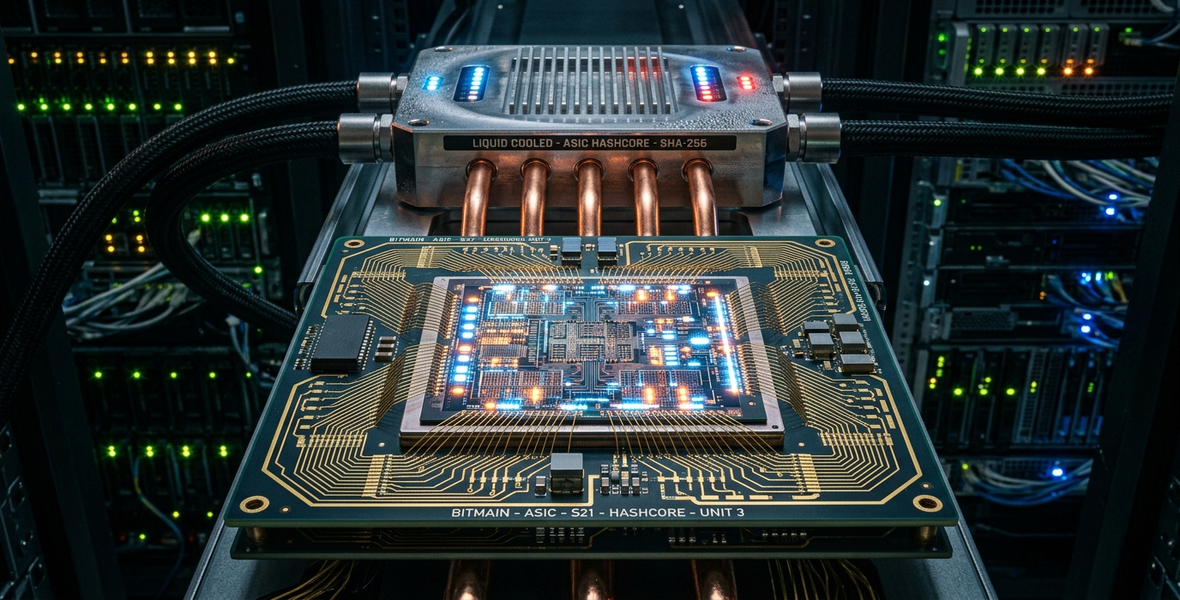
A modern mining ASIC chip, such as those powering top-tier Antminer or Whatsminer rigs, contains billions of transistors etched at cutting-edge semiconductor nodes (7nm, 5nm, and 3nm). Inside each silicon die, the physical architecture consists of hundreds of specialized Hashing Cores operating in parallel.
Here is what happens on the chip during every fraction of a microsecond:
- Block Header Ingestion: The mining software feeds the candidate block header (80 bytes) containing the previous block hash, Merkle root, timestamp, and target difficulty into the chip's input register.
- The Nonce Pipeline: The chip is assigned a specific 32-bit nonce space. It increments this integer rapidly, testing millions of combinations per second.
- Pipelined SHA-256 Rounds: The SHA-256 algorithm requires 64 rounds of bitwise logical operations (AND, OR, XOR, shifts, and rotations) on eight 32-bit working variables. In a CPU, these 64 rounds execute sequentially in software, consuming hundreds of clock cycles. In an ASIC, these 64 rounds are physically etched into copper and silicon pathways like a hardware assembly line. A candidate hash flows through the silicon gates in a single clock cycle.
- The Threshold Comparator: At the end of the pipeline, a hardware logic gate compares the resulting 256-bit hash against the current network target difficulty. If the hash begins with the required number of leading zeroes, an interrupt flag triggers instantly, transmitting the winning block to the blockchain network.
| Hardware Class |
Flexibility / Reprogrammability |
Energy Efficiency (Joules per Terahash) |
Hash Velocity per Watt |
Ideal Use Case in 2026 |
| CPU (x86 / ARM) |
100% (Universal) |
> 50,000 J/TH (Extremely Poor) |
Negligible |
Node validation, general computing |
| GPU (Nvidia / AMD) |
High (Programmable Shaders) |
~ 2,000 5,000 J/TH |
Low for SHA-256 |
AI model training, specialized altcoins |
| FPGA (Field Programmable) |
Medium (Hardware reprogrammable) |
~ 100 300 J/TH |
Moderate |
Algorithm prototyping, niche chains |
| ASIC (Dedicated Silicon) |
0% (Hardwired to 1 algorithm) |
15 25 J/TH (1,000x More Efficient) |
Massive (Terahashes per milliwatt) |
Enterprise Proof-of-Work Consensus |
Thermal Dynamics and Industrial Engineering: Why Retail Home Rigs Struggle
While the computational efficiency of ASICs is astonishing, their physics present daunting challenges for individual retail miners:
- Thermal Concentration: Compressing 3,500 Watts of electrical power through a package smaller than a postage stamp generates ferocious heat. Operating temperatures must be stabilized to prevent silicon degradation and electromigration.
- Acoustic Pollution: Dissipating this thermal load requires twin 6,000 RPM counter-rotating delta fans screaming at 80 to 90 decibelscomparable to a commercial lawnmower running continuously inside your room.
- Power Supply Requirements: High-density ASIC units demand dedicated 220V240V heavy-amperage electrical wiring that standard household electrical circuits cannot support without expensive rewiring.
The Virtualization Bridge: How MineX Farm Democratizes ASIC Efficiency
Because physical ASIC ownership is cost-prohibitive, noisy, and hot for everyday crypto enthusiasts, MineX Farm bridges the gap through Industrial Cloud Virtualization.
Our institutional facilities in renewable-energy jurisdictions handle the heavy engineering: liquid immersion cooling tanks, high-voltage transformers, redundant fiber-optic uplinks, and continuous firmware optimization. We partition these massive hardware clusters into modular, fractional computing power accessible via our interactive web dashboard:
- Zero Thermal or Acoustic Burden: You receive daily cryptocurrency yields without running deafening fans or blowing home fuses.
- Instant Hash Deployment: Select your preferred asset from our Mining Plans, whether Bitcoin, Dogecoin, Litecoin, or Polygon, and watch your hashing metrics update in real time.
- Maximum Uptime Guarantee: Hardware failures, burnt chips, and power fluctuations are absorbed and repaired by our on-site data center engineers without disrupting your payouts.
Conclusion: The Hardware of the Future, Accessible in One Click
ASIC microchips represent the pinnacle of human semiconductor ingenuity, translating physical thermodynamics into mathematical truth. You do not need to build an electrical substation in your garage to participate in this revolution. Let MineX Farm's enterprise data centers handle the silicon physics while you reap consistent, daily passive crypto rewards. Get started with our free $10 Starter Rack today and tap into the raw power of enterprise ASIC computation.
⚡ ZERO RISK • FREE WELCOME BONUS
Start Cloud Mining in Under 60 Seconds
Register your free account on MineX Farm today and instantly activate your complimentary $10 Starter Miner (50 MH/s). Real-time balance accumulation, zero hardware maintenance, and daily withdrawals.

 12 Oct