
 14 Oct
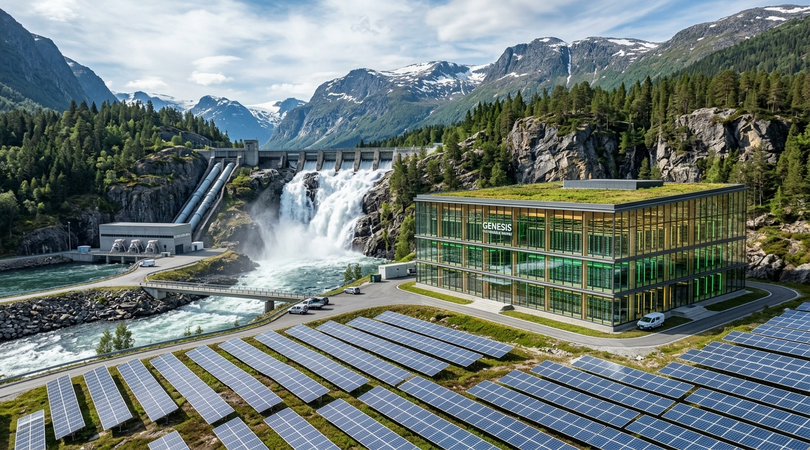
For years, the mainstream narrative surrounding cryptocurrency mining focused almost exclusively on its immense electrical appetite. Critics frequently cited high kilowatt-hour consumption figures while comparing global blockchain energy usage to entire sovereign nations. However, in 2026, the industrial mining paradigm has undergone a radical, technology-driven renaissance. Today, the most resilient and profitable cloud mining operations no longer rely on fossil-fueled municipal power grids; instead, they are engineered from the ground up around renewable energy sources\u2014predominantly run-of-river hydroelectric facilities, high-yield solar arrays, and geothermal reservoirs.
For cloud mining participants, this green transition is far more than an environmental virtue\u2014it is the single greatest determinant of contract cost-efficiency, operational uptime, and net mining yield. By understanding how renewable energy infrastructure insulates cloud facilities from power market shocks, investors can better appreciate why sustainable data centers represent the future of passive digital wealth generation.
Experience zero-carbon cloud mining with daily automated payouts and a free $10 trial bonus.
Claim Free Starter Miner »To grasp why energy infrastructure matters so profoundly to cloud miners, one must examine the cost structure of modern proof-of-work computation. Whether deploying high-density SHA-256 ASIC rigs for Bitcoin or Scrypt clusters for Litecoin and Dogecoin, operating expenses (OPEX) are overwhelmingly dominated by electricity. In traditional hosting facilities connected to mixed commercial grids, power costs typically range between $0.06 and $0.12 per kilowatt-hour (kWh). During seasonal peak-demand windows or geopolitical fuel crises, these retail rates can surge violently, compressing miner margins and occasionally forcing operators to throttle or power down hashboards entirely.
By contrast, dedicated green energy data centers establish direct power-purchase agreements (PPAs) with utility-scale renewable producers or build co-located off-grid generation facilities. Hydroelectric installations in Scandinavia, the Pacific Northwest, and Central Canada regularly deliver base-load power at sub-$0.03 per kWh. Because water flow across turbines is essentially free once capital expenditure is amortized, hydroelectric power offers both the lowest price floor and the most predictable long-term cost curve in the energy sector.
While solar and wind receive substantial consumer attention, hydroelectric generation possesses a decisive technological attribute essential for cryptocurrency hardware: continuous, uninterruptible baseload capability. ASIC microchips do not operate efficiently in intermittent cycles; starting, stopping, and thermal cycling silicon components accelerates micro-fracturing and shortens hardware lifespans. Hydro facilities provide an unrelenting, steady stream of three-phase alternating current day and night, ensuring that server racks achieve true 99.9% operational availability without requiring massive, costly battery storage buffers.
Furthermore, regions endowed with abundant hydroelectric potential frequently suffer from stranded power\u2014geographical locations where water flow exceeds local transmission capacity. Industrial cloud mining facilities act as synthetic energy export mechanisms. Rather than curtailing excess water spill at the dam, operators convert surplus megawatts directly into cryptographic security and globally liquid digital assets.
In arid, sun-drenched regions such as the American Southwest and parts of Southern Europe, solar photovoltaic (PV) arrays have achieved levelized costs of electricity (LCOE) that undercut even the cheapest fossil fuels during midday hours. State-of-the-art cloud facilities deploy hybrid architectures combining utility hydro baseload with hyper-dense on-site solar fields. During peak solar irradiation hours, automated energy management software shifts the facility's power draw to local PV generation, capturing sub-$0.02 marginal energy costs while exporting grid stabilization capacity back to regional operators during late afternoon demand spikes.
How does this industrial macro-engineering translate into tangible everyday advantages for individual retail participants managing virtual racks on platforms like MineX Farm? The connection is direct and measurable:
As the blockchain ecosystem matures through 2026 and institutional capital deepens its footprint across decentralized networks, the relationship between clean energy and computational security will only tighten. Cryptocurrency mining is no longer a fringe garage endeavor; it is an advanced energy arbitrage industry that actively incentivizes the rapid financing and construction of renewable generation projects worldwide.
By deploying your hashrate through modern, green-powered cloud architectures, you participate directly in this sustainable technological frontier\u2014securing decentralized networks, eliminating hardware headaches, and harvesting daily digital yields backed by the clean power of water and sun.
Register your free account on MineX Farm today and instantly activate your complimentary $10 Starter Miner (50 MH/s). Real-time balance accumulation, zero hardware maintenance, and daily withdrawals.